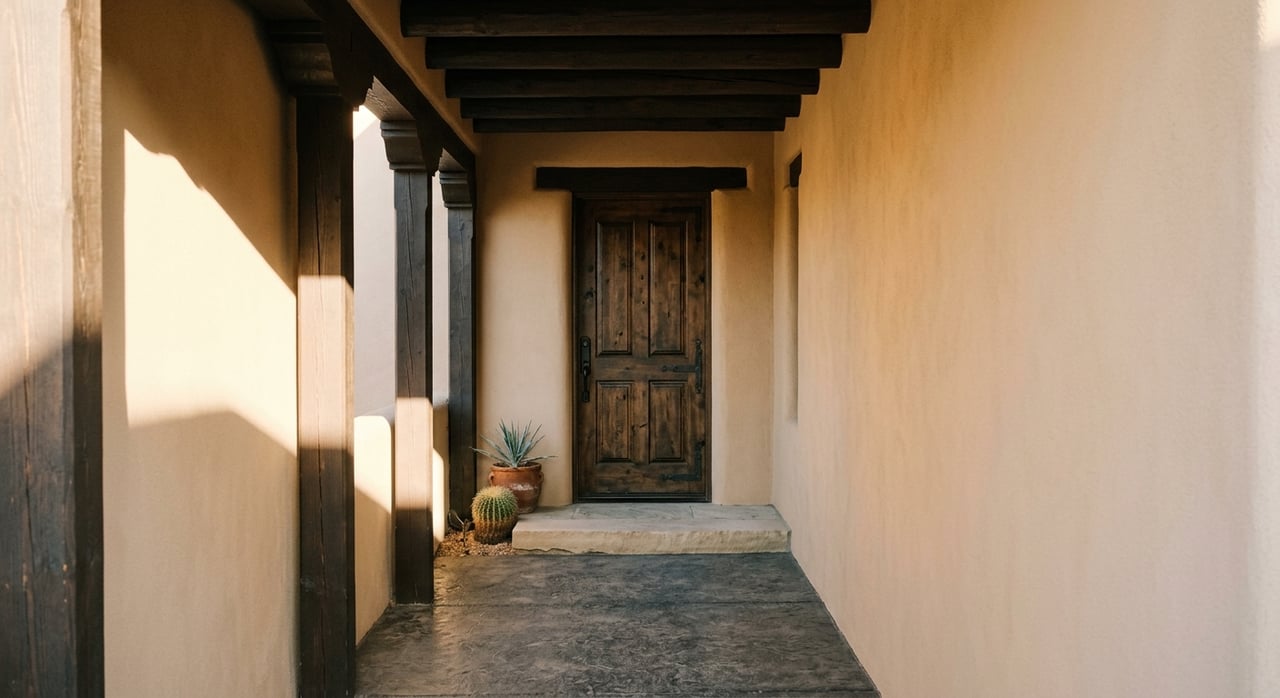
Custom Build Or Spec Home In Las Campanas?
July 9, 2026
July 9, 2026
If you are weighing a custom build against a spec home in Las Campanas, you are not choosing between two simple boxes. You are really choosing how much time, control, and complexity you want in your next move. For some buyers, a near-complete home offers a faster, cleaner path. For others, a homesite and a blank page are worth the extra steps. This guide will help you compare both paths in Las Campanas and decide which one fits your goals best. Let’s dive in.
In Las Campanas, the decision is rarely just “build or buy.” Current inventory can include finished or near-finished homes, to-be-built opportunities, and raw homesites.
That matters because each option offers a different balance of speed, customization, and budgeting. A near-complete home may let you move sooner, while a to-be-built offering can give you some design input without starting from scratch. A raw lot gives you the most control, but it also asks the most of you.
A spec home, or a near-complete new construction home, is usually the fastest route to ownership in Las Campanas. The floor plan, structure, and many finish decisions are already in place, so you are stepping into a more defined process.
That can be a major advantage if you want less project management and a clearer purchase number. In the current market snapshot, 23 Windridge Circle is an example of a home nearing completion, which puts it much closer to a move-in-ready purchase than a ground-up construction project.
Many buyers choose this path because it reduces moving parts. You are not starting with land selection, architectural planning, and a full permit file before construction can even begin.
A spec home can be a smart fit if you want:
The main tradeoff is flexibility. In most cases, you can only choose from what has not yet been completed.
That means you may be able to influence some finishes, but not the overall layout, site plan, or core architecture. If your vision is highly specific, this path may feel limiting.
A true custom build in Las Campanas starts with the lot. From there, the process moves through Santa Fe County development requirements, neighborhood rules, and the practical realities of site planning and utilities.
County guidance states that all building and development in Santa Fe County requires a development permit. For a single-family home, the application can include items such as a development application, state building application, HERS affidavit, utility proof, site plan, floor plan, roof framing, and grading and drainage documents.
If the application meets code requirements, the county says the development permit is issued within 15 business days. After that, approved sealed plans go to the New Mexico Construction Industries Division for the building permit.
Las Campanas custom buyers should look beyond floor plans and views. County requirements can affect design, timeline, and cost from the start.
For example, the single-family checklist requires a HERS rating of 70 or below. Homes that are 2,500 square feet or larger also need a water-harvesting plan with cistern capacity sized to capture 85% of the roofed area.
Not every lot will support every vision. Santa Fe County advises buyers to confirm zoning, confirm that the parcel is a legal lot of record, and resolve any existing unpermitted work before a permit will be issued.
In practical terms, that means your lot review should cover more than size and setting. You also want to know whether the parcel can legally and functionally support the home you want to build.
Las Campanas is not one-size-fits-all. The community includes different enclaves, and many have their own CC&Rs and design guidelines.
That means your design freedom may be narrower than you expect, even on a custom build. Minimum square footage, guest house rules, and builder guidance can vary from one enclave to another.
Here are a few examples from current Las Campanas materials:
Tesoro materials also include a preferred-builder selection guide. That is a useful reminder that some build opportunities are more builder-curated than fully open-ended.
Utility planning is one of the easiest things to underestimate. Some current Mesa de Oro homesites advertise community or cooperative sewer and water available.
At the same time, Santa Fe County permit materials still contemplate wells, septic, or other proof-of-service scenarios depending on the parcel. In other words, utility assumptions should be verified lot by lot.
If you are comparing custom build opportunities, this can be a major decision point. Two lots may look similar on paper but lead to very different planning and cost conversations.
The best choice usually comes down to three issues: how fast you want to move, how much design control you want, and how much complexity you are willing to manage.
Here is a simple side-by-side view.
| Factor | Spec or Near-Complete Home | Custom Build |
|---|---|---|
| Timeline | Faster path to ownership | More variable due to planning and permitting |
| Design flexibility | Limited to remaining selections | Highest flexibility within lot and enclave rules |
| Budgeting | More fixed purchase price | More moving parts and separate cost lines |
| Coordination | Lower project-management burden | More approvals and moving pieces |
| Risk tolerance | Lower decision fatigue and project risk | Greater need for patience and oversight |
If speed is your top priority, the spec path usually wins. A finished or near-complete home avoids much of the front-end planning that comes with land, design, and permitting.
For custom construction, the timeline is more variable because it depends on the lot, the plans, county review, and the neighborhood framework. The research available does not publish a single Las Campanas-wide average build duration, so it is better to treat each project individually.
A spec home is usually easier to budget because the price is more defined at the time you purchase. That can make planning simpler, especially if you want fewer surprises.
A custom build often separates the land cost from the construction cost. Local listings show this clearly. For example, the active to-be-built offering at 30 W Calle Ventoso states that the lot price is separate, which is a useful real-world example of how costs can stack in phases.
Custom building gives you the strongest voice in the outcome, but only within the lot’s conditions and the enclave’s rules. You may have freedom on layout and finishes, yet still need to work inside minimum square footage, guest house restrictions, and utility realities.
A to-be-built option can offer a middle ground. You may gain some customization without taking on the full complexity of a raw homesite and ground-up process.
If you value speed, simplicity, and a more predictable purchase structure, a spec or near-complete home may be the better fit. This path often works well for second-home buyers, relocators, or anyone who wants to reduce decision fatigue.
If you care most about tailoring the home to your priorities, a custom build may be worth the added time and coordination. This path can make sense if you are comfortable reviewing land details, neighborhood rules, utilities, and permit requirements before construction begins.
If you fall somewhere in the middle, a to-be-built offering may be your best match. It can provide partial customization while keeping more of the process defined from the start.
Before you choose a path in Las Campanas, it helps to answer a few clear questions:
Those answers usually point to the right lane. In Las Campanas, the best decision is often less about custom versus spec and more about how much process you want to take on.
When you want local guidance that connects the property search with real design, land, and build considerations, Ralph Alan Real Estate Group can help you evaluate the options with a practical Santa Fe lens.
Stay up to date on the latest real estate trends.
Article
Here's What It Actually Did
Get In Touch With Our Team To Learn More
Ralph Alan Real Estate Group
218 Camino La Tierra Suite B2 Santa Fe NM 87506 (505) 986-2000