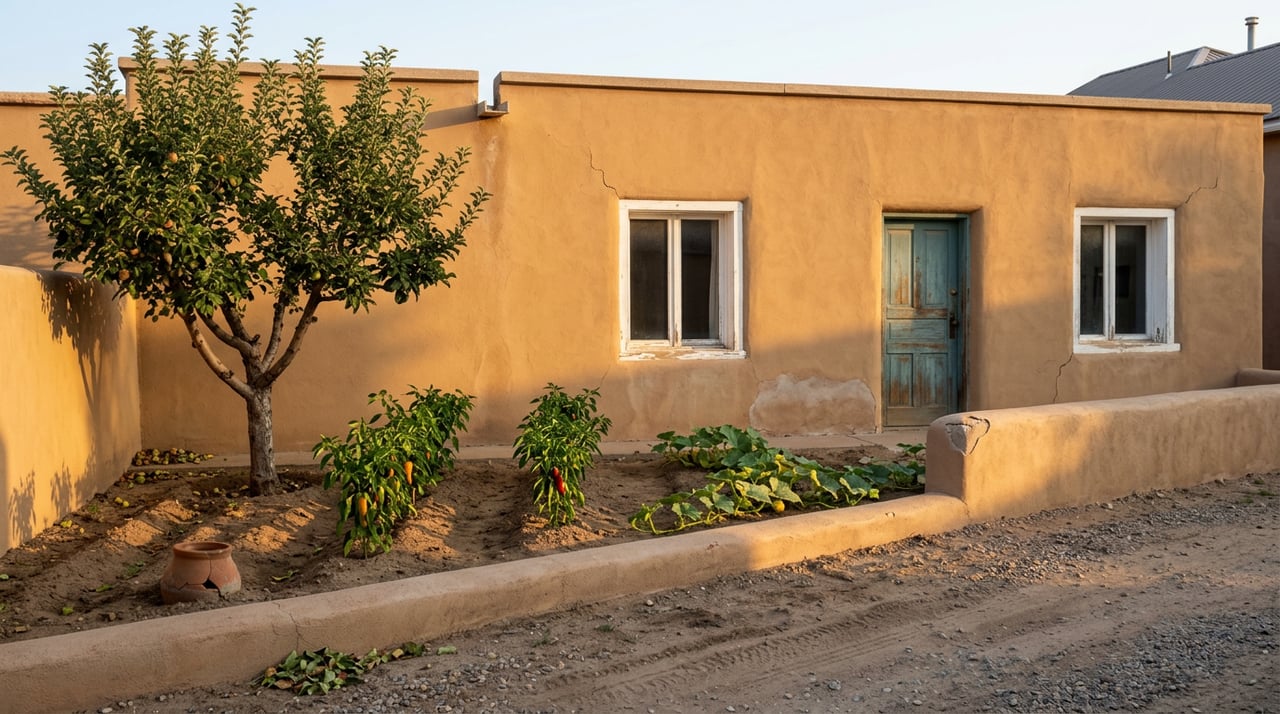
Agua Fria Village's Fall Season Arrives Before the River Trail Does
August 27, 2026
August 27, 2026
Saturday morning at the Reunity Farm Stand still smells like the last of summer. Baskets of Sun Gold cherry tomatoes and shishito peppers sit next to jars of local honey at 1829 San Ysidro Crossing, and the crowd that shows up between 9 a.m. and 1 p.m. is a mix of regulars with reusable bags and cyclists still catching their breath. Most of those cyclists didn't ride in on a dedicated trail. They rode the shoulder of Agua Fria Street, because the trail extension remains unfinished.
That gap between the calendar and the concrete is the thing worth understanding if you already call this village home. Agua Fria has spent decades building its own sense of place, and the fall season now underway offers a glimpse of village life.
Reunity Resources runs its Farm Stand on Saturdays from 9 a.m. to 1 p.m., May through October, which means the current run is closer to its end than its beginning. The nonprofit farm and soil yard at San Ysidro Crossing has spent the summer hosting free Lensic360 concerts alongside the produce tables, but the bigger date on the fall calendar is the farm's own celebration.
Fall Fest at Reunity Resources runs September 24 and 25, from 3 to 6 p.m. The lineup is straightforward and seasonal:
It reads like the kind of event that shows up in every small farm's fall programming, and in most towns it would be. What makes it worth noting here is where it sits relative to the neighborhood's broader story.
Drive west on Agua Fria Street and you'll pass a stone tower near the intersection with Skeeter Lane. It isn't ancient. Cornerstones, the Santa Fe preservation group, finished building it on July 9, 2021, using 60 tons of sandstone quarried by brothers Lee and Dave Romero in Villanueva. Master mason Alan Ash led the construction, tapering the tower from an eight-foot base to just over eleven feet at its highest point, topped with a cluster of prickly pear cacti. Then-county commissioner Anna Hansen helped secure $60,000 in county funding for it.
The tower marks the village's western boundary. An adobe monument and sign built in 2015 marks the eastern one. Together they bookend a place that, in 1995, won designation from Santa Fe County as a Traditional Historic Community, a status that protects it from being annexed by the city. A Yahoo News report quoted William Mee, who has led the village's historic association, describing the village's distinct identity in relation to the city.
That instinct to mark boundaries in stone runs alongside an older instinct to gather around faith and farming. Residents built San Isidro Church in 1835, naming it for the patron saint of farmers, and the village still marks his feast day each May 15 with blessings for rain and harvest, decades after the Santa Fe River's damming reduced the water that once made this a farming hub.
The village's identity and its infrastructure projects have developed on different timelines.
Santa Fe County voters approved $6.7 million in bond funding across two elections to extend the paved Santa Fe River Trail one mile west from its dead end at Siler Road to San Ysidro Crossing in Agua Fria, with the extension also unlocking an adjacent mile-long dirt path to Romero Park. Officials broke ground on the segment in September 2024. As reported by KRQE, resident Juliana Ciano described at the groundbreaking what the finished trail would mean for daily life in the village:
"we can bike places whether that's school, or the ice cream shop or friends and neighbors' houses"
The reason it's taking longer than a typical mile of pavement has to do with the river itself. A Santa Fe New Mexican report quoted project manager Mike Hart explaining that crews are "putting in structures to actually slow the water down and redirect it," reworking the floodplain to meet federal requirements before a single stretch of trail can be poured.
County officials projected the extension would be finished by fall 2025. As of January 2026, according to trail-tracking site Great Runs, it still hadn't opened.
| Milestone | What was promised | Status |
|---|---|---|
| Bond approval | $6.7 million across two elections | Completed |
| Groundbreaking | September 2024 | Completed |
| Trail extension to San Ysidro Crossing | Fall 2025 | Not open as of January 2026 |
| Connector to Romero Park | Included with extension | Pending trail completion |
The wastewater project is a separate infrastructure effort. In August 2025, Santa Fe County commissioners signed off on engineering design for Phase IV of a wastewater project that is planned to bring sewer infrastructure to nine more streets in the village. A Santa Fe New Mexican report recounts William Mee's account of a resident who asked the county for sewers in 1950, saying only "we need sewers in Agua Fría village."
If you live here, the pattern is familiar. Infrastructure projects and community initiatives unfold on different timelines.
While the river trail extension sits unfinished, the actual bike traffic to the Farm Stand has found its own route. On July 25, 2026, the Santa Fe Conservation Trust's Trails Program Manager, Tim Rogers, led a 25-rider "Bike-to-Farm-Stand" ride from the Railyard Community Room, riding the entire way down the Acequia Trail rather than waiting on the river trail's unfinished western stretch. The city's own Bicycle Master Plan lists the Acequia Trail as a route with a direct connection to Agua Fria Street, which is exactly why the ride worked without needing the missing mile of pavement.
For a resident planning a ride to Fall Fest, that's the more useful map right now:
Frenchy's Field Park deserves credit here too. The 16-acre park, built on the site of the old Frenchy's Dairy Farm, already does the connective work the trail extension is meant to finish, linking to the river trail by footbridge and offering a meditation circle, a labyrinth, and enough open ground that prairie dogs have claimed a corner of it as their own. It has been functioning as the village's informal town square long before any bond measure was on a ballot.
Agua Fria has its own church, its own historic designation, and its own stone monuments marking where it begins and ends. The Farm Stand season closing out this fall, the Fall Fest crowd arriving by bike on September 24 and 25, and the wastewater project all illustrate different timelines in village life.
If you're already part of that rhythm, you don't need a real estate agent to tell you where the Farm Stand is. But if you're weighing what a home in a place like this is actually worth, given a historic designation that limits annexation, a farm that anchors the calendar, and infrastructure projects unfolding over time, that's a conversation grounded in local specifics rather than a countywide average. Ralph Alan Real Estate Group works these Santa Fe neighborhoods block by block, and we're happy to talk through what any of that means for your own address when the time comes.
This article is general information, not legal, tax or financial advice. Consult a qualified professional about your situation.
Stay up to date on the latest real estate trends.
Article
Here's What It Actually Did
Get In Touch With Our Team To Learn More
Ralph Alan Real Estate Group
218 Camino La Tierra Suite B2 Santa Fe NM 87506 (505) 986-2000